
for the same food output, depending on crop and growing method
Engineering modelA SMALL FARM FOR MORE PLACES
A farm the size of a backyard shed.
Built to grow food year-round, where people are.
10 × 12 ft farms for year-round local food production.
Raising $150,000 to secure High Street as our home base and working demo site, and develop prefabrication so we can build, ship, and install more Littlest Big Farms.
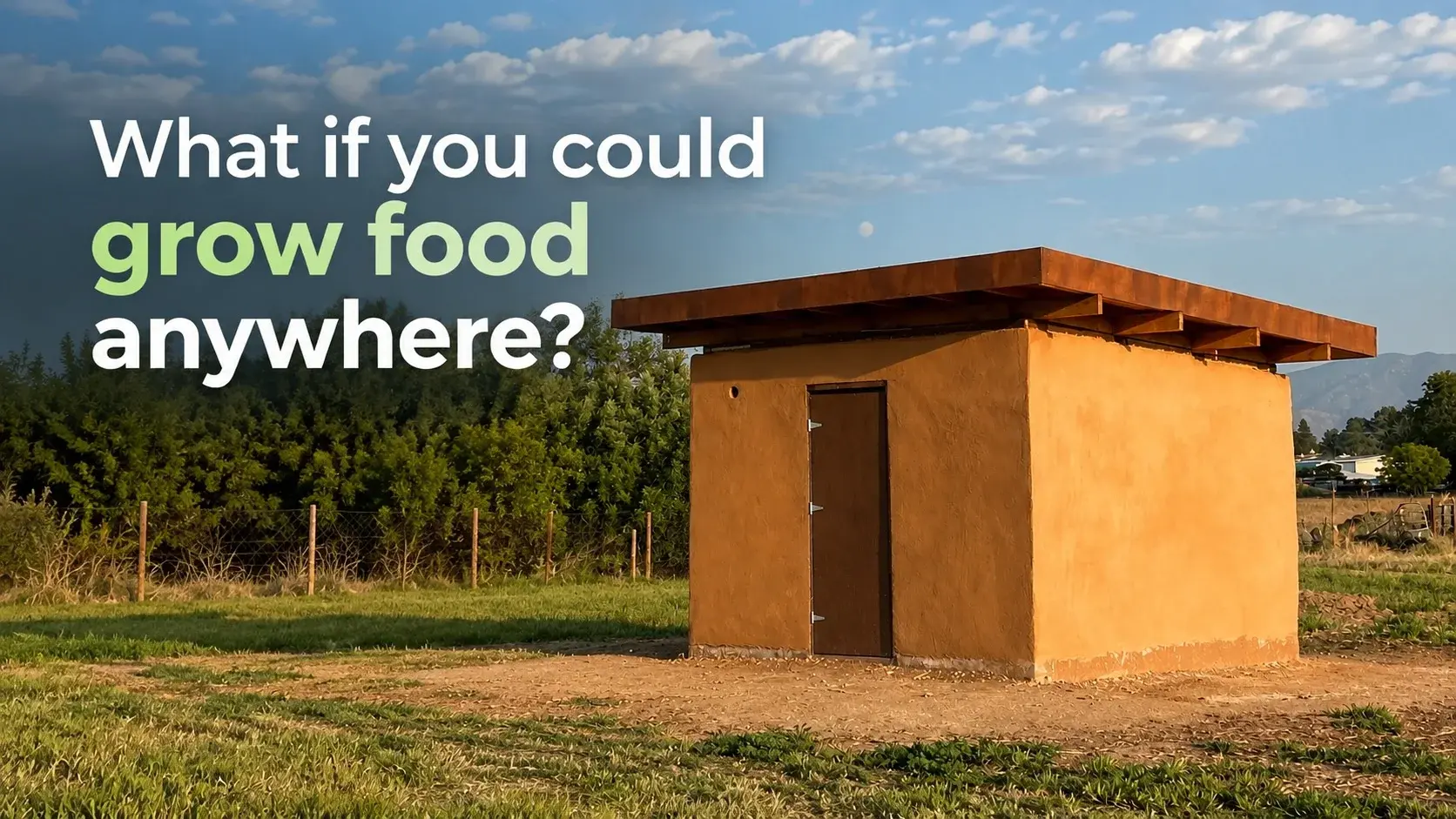
Why we went tiny, what we built, and what comes next.
Built by us. Grown with you. · Cherry Valley, California
WHAT THIS CROWDFUNDING IS FOR
- Secure High Street as our long-term home base.
- Build and test the first prefabricated wall systems.
- Fund materials, engineering, and safety validation needed to move prefab forward.
THE CASE FOR A LITTLE FARM
What if more food could be grown year-round, right in your backyard?
For seven years, we have been developing, building, and operating Littlest Big Farms, shed-sized growing systems designed to help people produce meaningful amounts of fresh food locally, year-round.
Not bigger agriculture. Small-scale food production made possible for more people.
See what we have actually grown. Browse real grow photos from over the years →
WHAT THE NUMBERS SUGGEST
Strong potential, backed by years of operating experience and continued validation.
Our operating experience, measured data, engineering models, and hydroponic benchmarks suggest the following potential:
than field growing, based on hydroponic production benchmarks
Benchmark-basedmodeled against a comparable insulated structure
Measured data + modelmodeled against commercial vertical farming in our high-productivity scenario
Measured data + modeled comparisonfrom high-value local crops at roughly 10 hours per week, depending on crop, market, yield, and operating costs
Operating experience + crop economicscould be avoided per 1,000 lb of food for every 1,000 truck-miles displaced by local production, before accounting for local delivery. Food grown inside also needs no field tractor passes for tillage or harvest.
EPA SmartWay scenario + USDA farm-energy contextare linked to food cold chains. Growing near demand can reduce time spent in refrigerated transport and storage for foods that would otherwise depend on them.
UNEP system benchmarkglobally. Shorter grow-to-eater chains mean fewer handoffs and less time in transit and storage, creating an opportunity to reduce pre-retail loss.
FAO system benchmarkHow to read these numbers: These are not promises of performance or income. The resource figures combine measured operating data, engineering models, and external hydroponic benchmarks that we continue to validate. The economic range is informed by our operating experience and crop economics and will vary by crop, market, yield, labor, and operating costs. The freight estimate is a scenario using EPA SmartWay's U.S. truck average of 210 g CO₂ per short ton-mile; actual savings depend on the route displaced and any local delivery. The cold-chain and food-loss figures are global system benchmarks, not claims that a Littlest Big Farm eliminates those impacts entirely.
WHY THIS MATTERS
Growing food outside is becoming less predictable.
This year in Cherry Valley, California, extreme heat made something we already knew feel much more immediate: growing food outside is becoming less predictable.
Littlest Big Farms are not meant to replace orchards, gardens, or traditional farms. They are another tool: a small, protected growing environment designed to keep producing when heat, cold, wind, pests, drought, or unpredictable weather make outdoor growing difficult.
BUILT TO FIT WHERE PEOPLE ARE
The size of a backyard shed.
That means a Littlest Big Farm could fit in a backyard, school, restaurant, small farm, business, or community.
We have built and operated our first production-generation Littlest Big Farm. Now we are raising $150,000 to secure our home base, develop prefabrication, improve key systems, and build and install more farms.
A little farm. A future we can grow together.
7 yearsbuilding + testing
3LBF generations
40+crop species grown
50+farmers + farmworkers trained
USDA SBIR Iearly R&D support
UCR OASISoutside validation + support
WHY TINY?
Smaller is not the point. Distributed is.
A distributed network spreads growing capacity across many sites instead of concentrating production, capital, and risk in one giant facility. One farm going offline does not have to stop every other farm from producing.
Spread production across many sites.
Many smaller farms create redundancy. A failure, outage, or local disruption at one site does not automatically become a failure of the whole network.
Grow food closer to people.
Put protected growing capacity beside homes, on small farms, at schools, nonprofits, campuses, restaurants, and community sites instead of concentrating production in a few distant facilities.
Protect each farm and use resources carefully.
Heat, cold, wind, pests, drought, and unpredictable weather can interrupt production. Protected growing, thermal mass, sensors, and controlled systems give each site another layer of resilience while we continue validating land, water, and electricity performance.
Many small farms.More local production.Less dependence on one place.
THE LITTLEST BIG FARM
Tiny by design. Serious about growing.
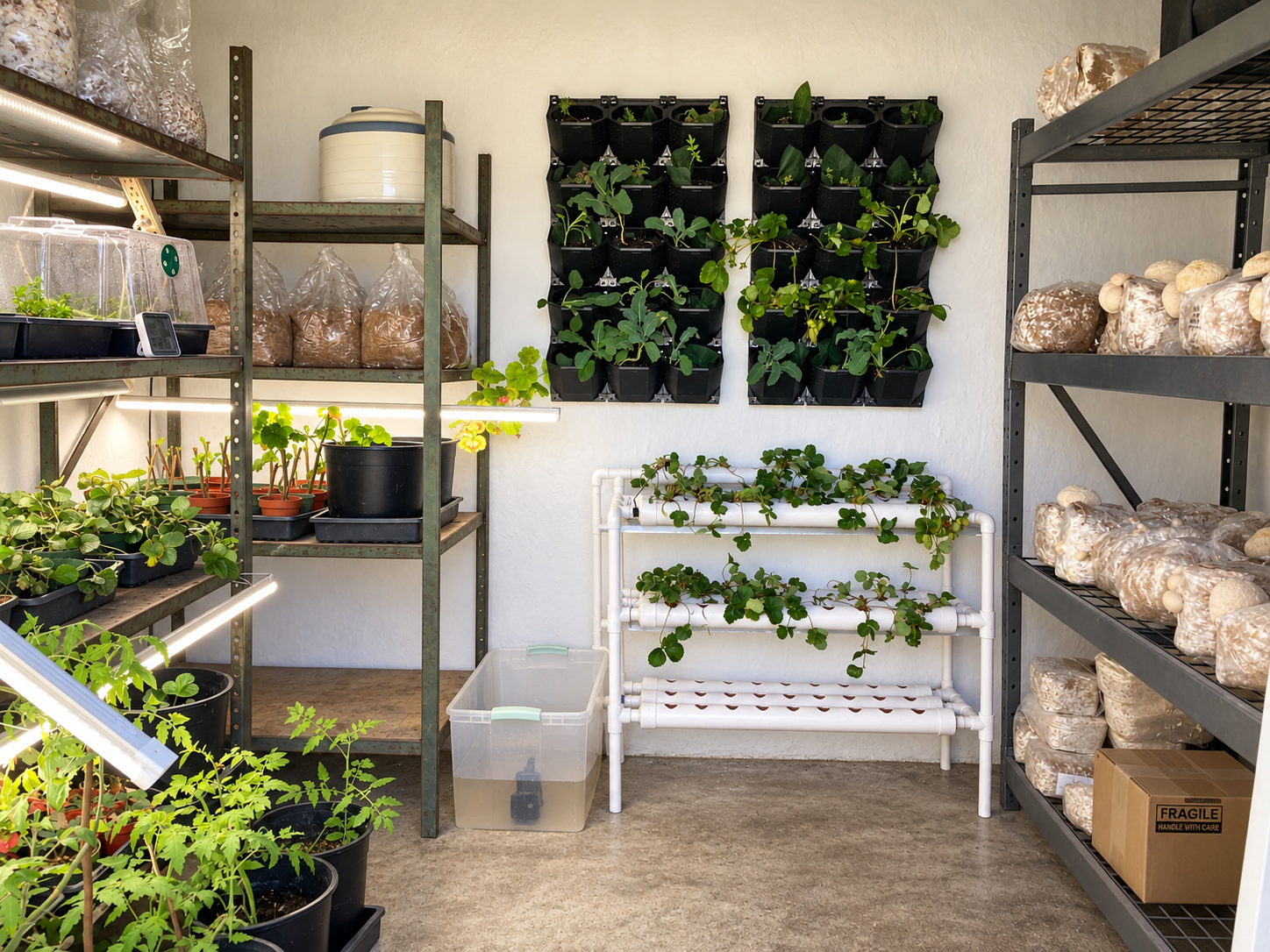
A compact controlled growing environment that combines earthen building physics with sensors, controls, and crop-specific systems.
Protected.Designed to buffer crops from heat, cold, wind, pests, and changing outdoor conditions.
Configurable.One platform can be adapted around different crops and growing methods instead of locking every farm into one recipe.
Learnable.Every deployment can feed real operating experience back into the next farm, the next operator, and the next version.
Actual configuration, energy use, crop suitability, production, and economics vary by climate, site, crop, equipment, and operation.
NOT AN IDEA ON A NAPKIN
We did the expensive learning before asking the public to help us scale it.
Seven years of successive farm generations, crops, training, grants, sales, failures, and fixes brought us to a different problem: how to make the next farm easier to build than the last.
01Build
Three generations of Littlest Big Farm R&D moved the concept from early work into real protected growing systems.
02Grow
More than 40 crop species have been grown across our systems, giving us operating experience beyond a single showcase crop.
03Teach
More than 50 farmers and farmworkers have gone through From The Land training and funded agricultural programming.
04Scale next
The bottleneck is no longer proving that we can build and grow. We have a working MVP and documented build. The next step is prefabrication, shipping, installation, and growing the company around that capability.
Outside support has helped us get here.Earlier work has received support through programs including USDA SBIR Phase I and UCR OASIS, alongside other grants, contracts, and partnerships. Prior support is not counted again in this campaign total.
WHAT THE FIRST $150,000 DOES
What the first $150,000 helps us do next.
We already have a working minimum viable product, structural-engineered plans, signed-off county permits, a materials list, controls package, build sequence, documentation, and quality checks. The next milestone is building the capability to prefabricate, ship, and install Littlest Big Farms in more places.
The campaign is not about proving we can build a Littlest Big Farm.We already have a working MVP and a documented build process. The next step is securing and equipping the right place for prefabrication, then testing how much of each farm we can build, wire, test, ship, and prepare before installation.
See campaign-backing and use-of-funds details
The $150,000 milestone is focused on securing and equipping prefabrication capacity, testing prefab/shipping/installation, professionally manufacturing selected systems, building the next farms, and the working capital needed to keep From The Land operating and growing while that work moves forward.
Total Campaign Backing includes initial funding, completed gifts and reward purchases, confirmed loans and investments, other confirmed support, and completed Littlest Big Farm Priority Reservation payments. Refundable reservation payments are identified separately. Donations to Esperanza's Sanctuary go directly to the nonprofit and appear only in its separate tracker.
CHOOSE HOW YOU WANT TO HELP
Choose the way of helping that fits you.
Give directly, choose a reward, make a tax-deductible donation through Esperanza's Sanctuary, discuss a loan, or contact us about a SAFE.
Back the Build
Choose any amount and help us build the next stage: prefabrication, shipping and installation testing, better-manufactured systems, the next farms, and the working capital to keep From The Land moving. A small gift does not build a farm by itself; many small contributions can move the same work forward.
From The Land LLC is a for-profit business. Gifts to us are not tax-deductible charitable donations.
Prefer a reward?
Rewards are still part of the campaign. We keep them one step deeper so the main page stays focused on what the campaign is trying to make possible.
Fulfillment queues, batches, and scheduling
Physical rewards are placed in a fulfillment queue in the order paid. Where a reward shows a Batch 1 quantity, that is the amount we are committing to in the first release, not a lifetime limit. If demand is strong and capacity supports it, we can open a later batch with a later fulfillment window.
Custom designs require an agreed scope. Workshop and tour dates are scheduled by mutual availability. Current fulfillment or scheduling windows are shown on each reward, and cancellation/refund rules are covered in our published campaign terms. The $1,000 mealworm subscription is one payment covering 24 monthly deliveries. Littlest Big Farm Priority Reservations are offered separately below. Completed reservation payments count toward total campaign backing but are shown separately because they remain fully refundable until a Final Purchase Agreement.
Make a tax-deductible donation to Esperanza's Sanctuary
Esperanza's Sanctuary is a 501(c)(3) nonprofit partner in Sky Valley, California (EIN 87-4749533). Its Littlest Big Farm fundraiser is separate from From The Land's campaign, so donations go directly to the nonprofit through its own Zeffy page.
$60,000partner project goal
Partner fundraising total will be reported when available.
Sponsor the full $60,000 projectYour donation goes directly to Esperanza's Sanctuary through its Zeffy page, outside our cart. As a 501(c)(3), charitable contributions to Esperanza are generally tax-deductible to the extent allowed by law and subject to the donor's circumstances. A person, family, foundation, or company can also contact us about funding all or a major portion of the $60,000 project. These funds are tracked separately from From The Land's campaign total.
Provide debt financing.
If you would rather lend than donate, contact From The Land directly to discuss the amount, interest rate, term, repayment schedule, collateral if applicable, and written agreement.
Loans are arranged directly with us, outside checkout. The interest basis, terms, and risks will be set out in the agreement.
Invest with a SAFE.
Interested in helping build the future of Littlest Big Farms? Talk with us about a Simple Agreement for Future Equity (SAFE).
A SAFE is an investment agreement, separate from gifts, rewards, and loans. Terms, eligibility, and risks are discussed directly; no investment is purchased through this cart.
Your idea belongs here, too.
Have skills to share, supplies to contribute, a partnership in mind, or another way to help? Tell us what you’re thinking.
You can also invite friends to discover the campaign using the share button in Updates.
MORE WAYS TO HELP
More details on other ways to help.
If one of these paths fits you, here are the details and the right next step.
From The Land loans and investments are handled directly under separate agreements. Esperanza's Sanctuary donations go directly to the nonprofit through Zeffy. In-kind support is coordinated directly.
FROM ONE HOME BASE TO MANY SMALL FARMS
The network is the point.
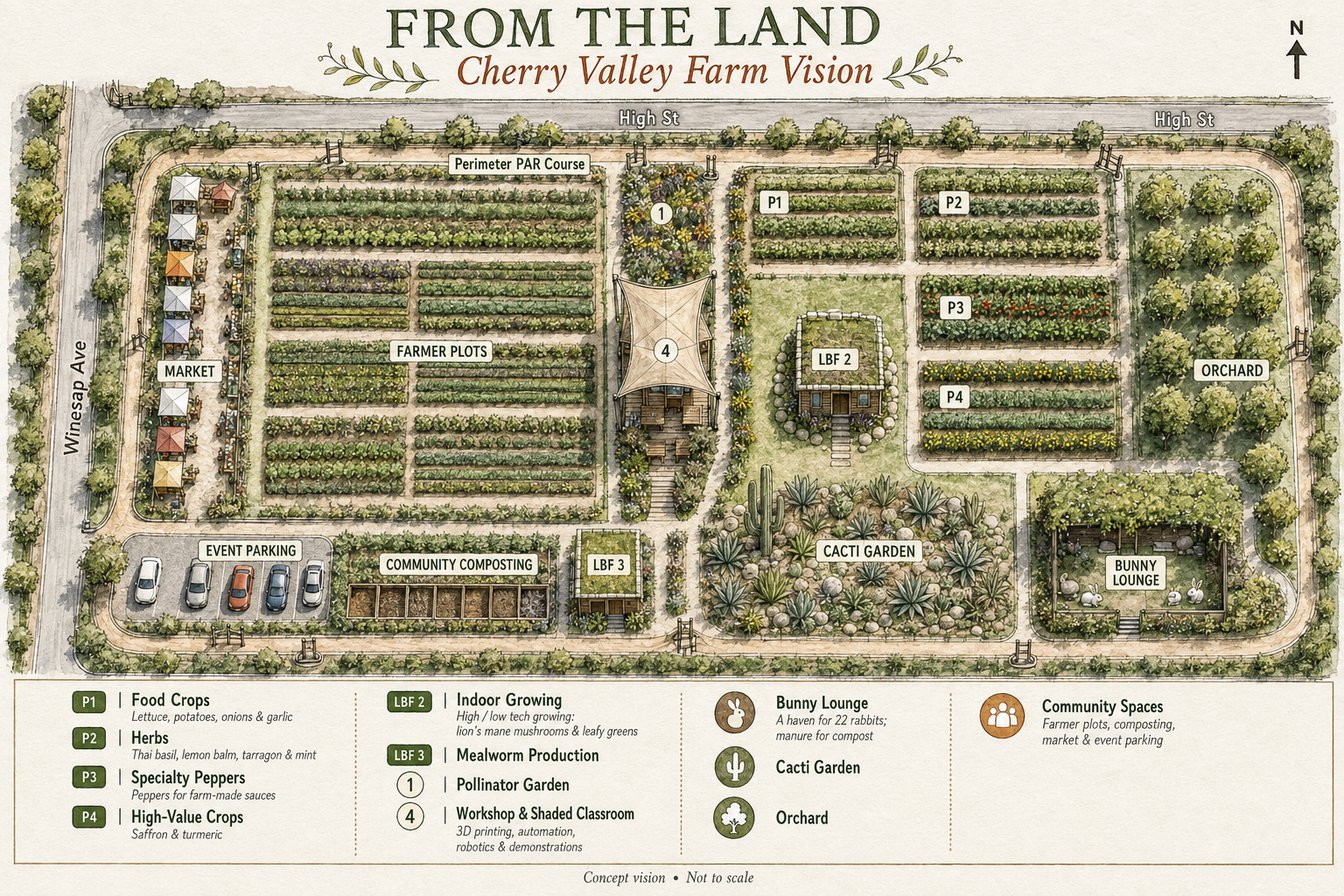
Cherry Valley is where we standardize and learn. The long-term goal is many small protected farms operating in many places, so food production is distributed rather than concentrated in one facility or one community.
FROM THE LANDBuild + test + train
↓
Littlest Big Farmsrepeatable platform + local operators
↓
HomesSmall farmsSchoolsNonprofitsUniversitiesCommunities
Resilience through distribution. A problem at one farm does not have to stop the rest of the network. Production is spread across many sites instead of depending on one giant point of failure.
Every deployment teaches the next one. Operating experience can flow back into better farms, better training, and better support.
This is our long-term operating vision, not a launched franchise or membership offering.
THE PEOPLE BEHIND IT
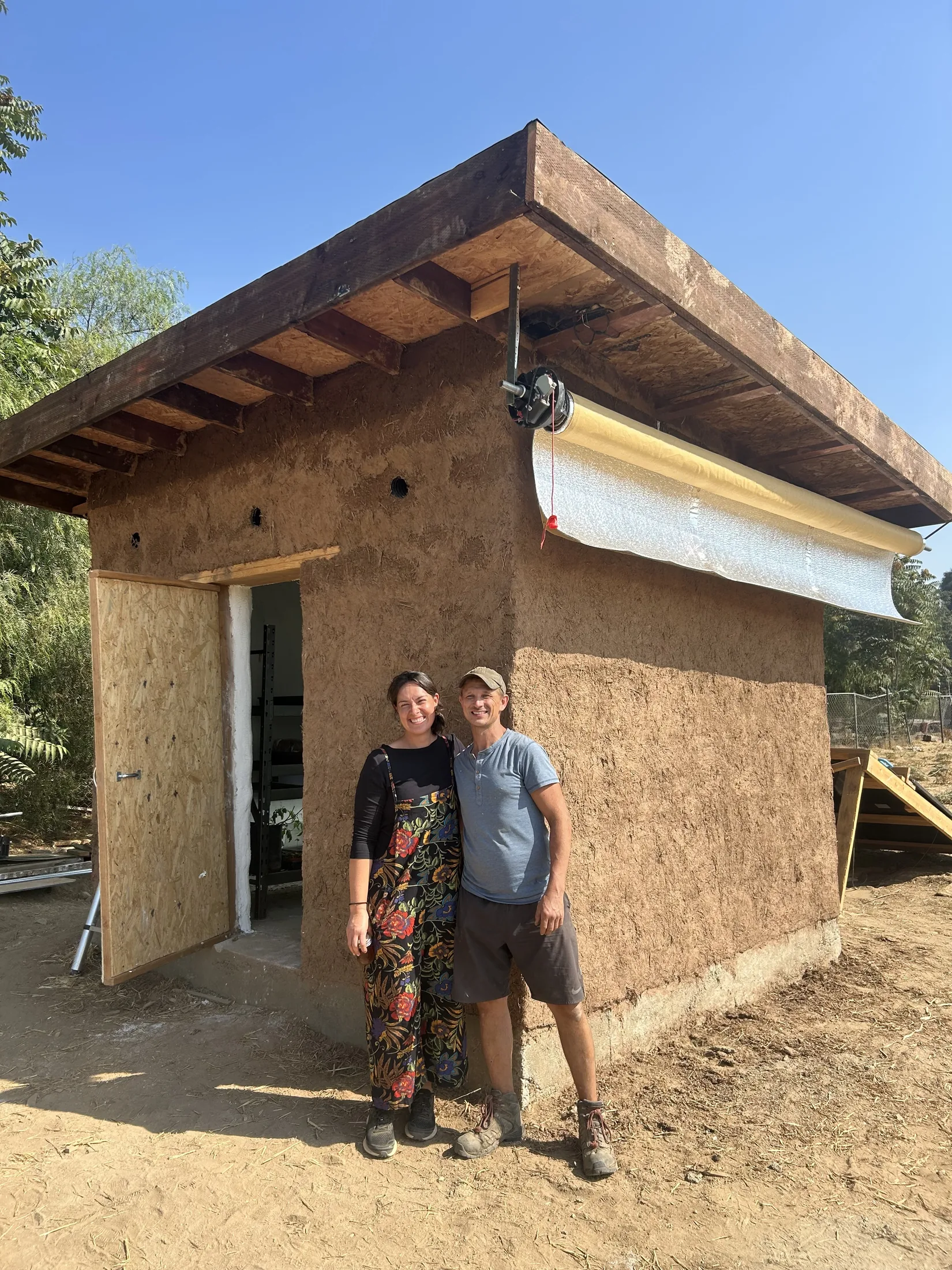
A scientist, an engineer, and seven years of making the idea real.
Gina is a scientist and educator. Rich is a materials engineer and builder. Together, they have spent seven years turning the idea into working structures, real growing systems, farmer training, and a production problem they are now ready to solve.
Seven years of hands-on work.Building, growing, testing, teaching, fabricating, fixing, rebuilding, and learning.
They have sold agricultural products, trained farmers, written grants, built successive generations of Littlest Big Farms, fixed what broke, and kept going because they believe food infrastructure should create both local resilience and work people can build a future around.
We did not spend seven years trying to make a bigger farm. We spent seven years learning how small a farm could be and still matter.
WANT ONE IN THE NETWORK?
Want one of your own?
This is a reservation, not the purchase or installation of a farm. Final configuration, pricing, delivery, and any separately contracted site or solar work come later.
This is not the purchase of a Littlest Big Farm and is not an installation or construction contract. When your place approaches production, we will work with you on final configuration, pricing, delivery, and any separately contracted installation or solar options.
- Fully refundable until a later Final Purchase Agreement.
- Reservation payments are shown separately in Total Campaign Backing.
FOUNDING CREW
The First 100
These are founding supporters who chose to put their names on the wall. Anonymous supporters count toward the First 100 too.
Names appear here after Square confirms payment. Contribution amounts are never displayed.
Updates from the farm
The details, when you want them.
What exactly is the $150,000 campaign funding?
The first milestone is focused on securing High Street as our long-term home base and prefabrication location, testing and improving the prefab process, professionally manufacturing key systems where it makes sense, and building, shipping, and installing more Littlest Big Farms. High Street also gives us a stable demonstration site for buyers and investors and a place for continued innovation, workshops, and community learning.
Is this a campaign for the Cherry Valley property?
High Street in Cherry Valley is part of the campaign because securing it gives From The Land a stable long-term base for prefabrication, demonstrations, testing, innovation, workshops, and community learning. It is one part of the larger goal: building, shipping, and installing more Littlest Big Farms.
Is my gift to From The Land tax deductible?
No. From The Land LLC is a for-profit business. Gifts and reward purchases through this cart are not charitable tax-deductible donations. Esperanza's Sanctuary is a separate 501(c)(3) nonprofit (EIN 87-4749533). Donations made directly to Esperanza through its nonprofit giving page are generally tax-deductible to the extent allowed by law and subject to the donor's circumstances.
Can someone sponsor the entire Esperanza's Sanctuary project?
Yes. Esperanza's separate project goal is $60,000. A person, family, foundation, or company can fund all or a major portion of it. Contact us and we will coordinate directly with Esperanza so the charitable contribution goes to the nonprofit rather than through From The Land's campaign checkout.
How do the reward choices work?
Each reward tier includes your choice of one listed option. Add more quantities to receive more of that choice, or add a different choice from the same tier separately. The $1,000 mealworm subscription is one payment for 24 monthly deliveries of 5,000 live mealworms; it is not a recurring monthly charge.
What does the $6,000 Littlest Big Farm Priority Reservation cover?
It secures approximate priority in our Littlest Big Farm production queue. It is fully refundable until you enter a later Final Purchase Agreement, and it is not the purchase of a complete farm or a construction, installation, or solar agreement. When your place in the queue approaches, we will work with you on configuration, final pricing, delivery, and any optional installation or solar services. Those services are priced and contracted separately as applicable.
How does checkout work?
Once checkout opens, Square will securely handle payment details on its hosted checkout page. We update the campaign only after Square confirms the payment to our campaign backend.